

Charles Bonas, founder of Bonas MacFarlane Education, recently featured in Country Life, shares his perspective on the enduring importance of school uniform, tradition and belonging.
There are few things quite as evocative as a distinctive British school uniform.
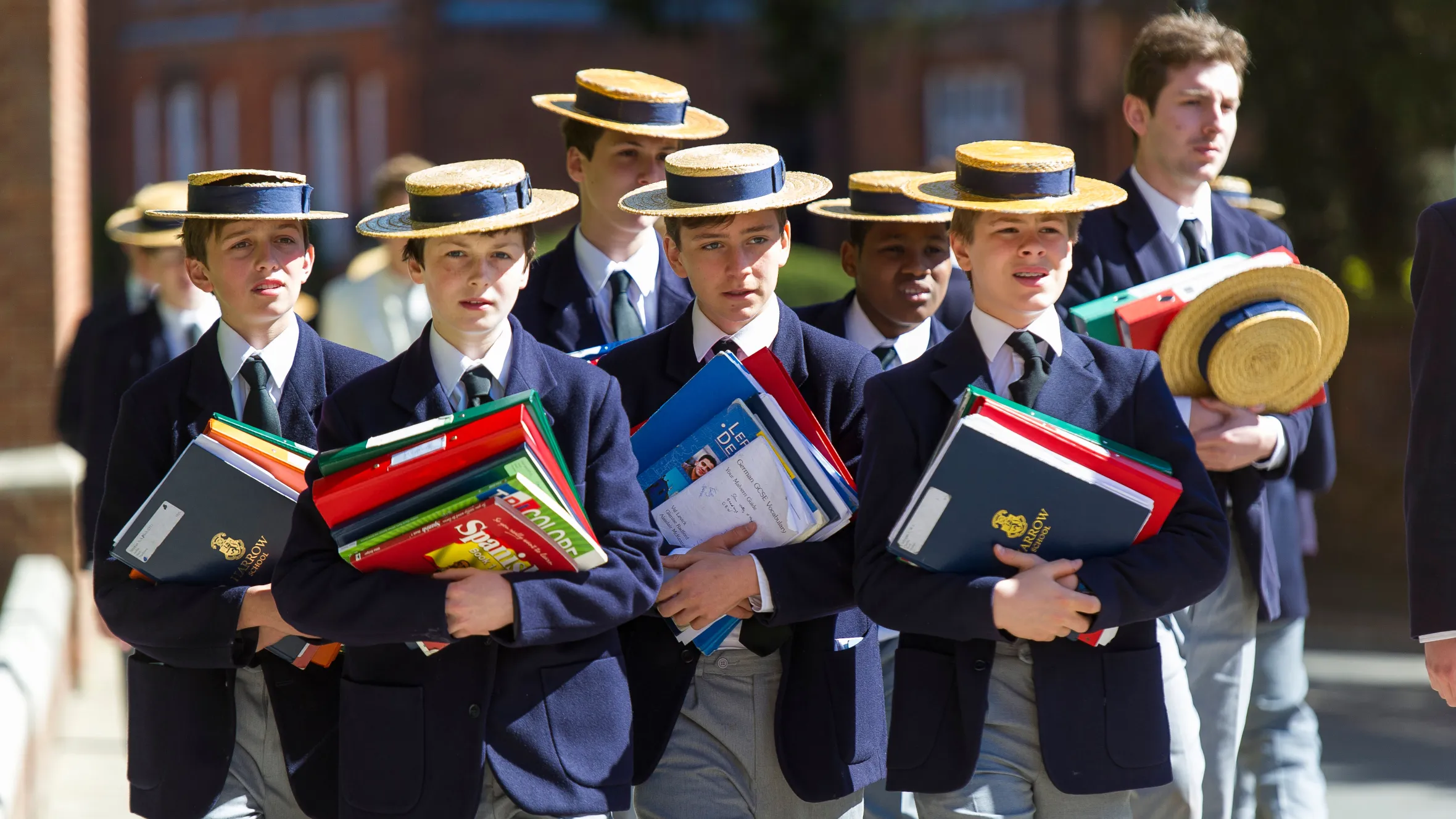
From Harrow’s famous straw boater to Winchester’s academic gowns, Redmaids’ High’s ceremonial capes and the rust-coloured breeches of Hill House, these uniforms are more than simply clothes. They carry stories, traditions and a strong sense of identity, often stretching back generations.
As Charles Bonas, founder of Bonas MacFarlane Education and an Old Harrovian, explains in Country Life, there is something important about preserving these traditions.
“We have a long, continuous history in this country and it’s good to celebrate that.”
For Charles, school uniform is also fundamentally about equality and community. The clue, he suggests, is in the name: uniform.
More than just clothing
At its best, uniform creates a sense of belonging. It removes some of the pressures of fashion and encourages pupils to see themselves as part of something larger than themselves.
This is particularly evident at schools where uniform has become inseparable from their identity.
At Hill House, for example, children have long worn rust corduroy breeches and culottes, paired with gold and rust cravats and open-knit woollen sweaters. The unusual uniform is instantly recognisable, so much so that pupils travelling through Heathrow are frequently stopped by former pupils who remember it fondly.
The uniform was originally designed with practicality in mind. Hill House’s founder, Beatrice Townend, believed that a grey uniform produced grey minds, while her husband Stuart modelled the school’s distinctive breeches on his own climbing clothes. The intention was that children could move effortlessly between classroom and sports field without having to change.
Today, that practicality has evolved into something equally valuable: a visual expression of the school’s history and shared culture.
Tradition with room for individuality
Of course, uniform doesn’t mean that individuality disappears.
British schools have always found ways for pupils to express themselves within the boundaries of their dress codes, sometimes with considerable creativity.
Charles reflects on his own time at Harrow, where conventions surrounding the school’s distinctive hats have changed over generations. What was once considered a questionable use of the hat strap is now commonplace.
These small changes are part of what makes school traditions interesting. They evolve, but rarely disappear entirely.
At Harrow, the uniform comes with a complex set of traditions governing striped jackets, fezzes, caps, ties, waistcoats and ceremonial dress. Even seemingly minor infringements can become memorable rites of passage.
Far from being simply restrictive, these traditions can create a shared language between pupils, teachers and generations of alumni.
Why heritage matters in education
It is easy to dismiss traditional uniforms as archaic or to view them simply through the lens of social history. But heritage can play a meaningful role in a child’s education.
A school is not only a place where academic knowledge is acquired. It is also a community, with its own values, rituals, stories and traditions.
Uniform can be one of the most visible expressions of that community.
For Charles, this is particularly important in an era when children are increasingly exposed to commercial pressures and social comparison.
A uniform cannot and should not remove individuality. But it can help create an environment in which pupils are not constantly competing over what they wear, what they own or which trends they follow.
Instead, they share a common identity.
The enduring appeal of school tradition
Perhaps this explains why Britain’s most distinctive school uniforms continue to inspire such affection.
They may seem quirky to an outsider, but to generations of pupils they become woven into the experience of growing up.
The boater, the blazer, the cap, the gown or, indeed, the breeches become symbols of friendships, school trips, ceremonies, sporting occasions and memories that last long after a pupil has left the classroom.
As education consultants, we see every day that choosing a school is about far more than academic outcomes. Families are considering a school’s culture, values, character and the environment in which their child will grow.
Uniform is only one small part of that picture but it can tell us something meaningful about how a school understands itself.
And perhaps that is why, however eccentric the uniform may seem, there is still something rather special about putting it on.
Read Charles Bonas’s comments in the latest issue of Country Life, where he reflects on the heritage, rituals and enduring appeal of Britain’s most distinctive school uniforms.
(Image credit: Future)