

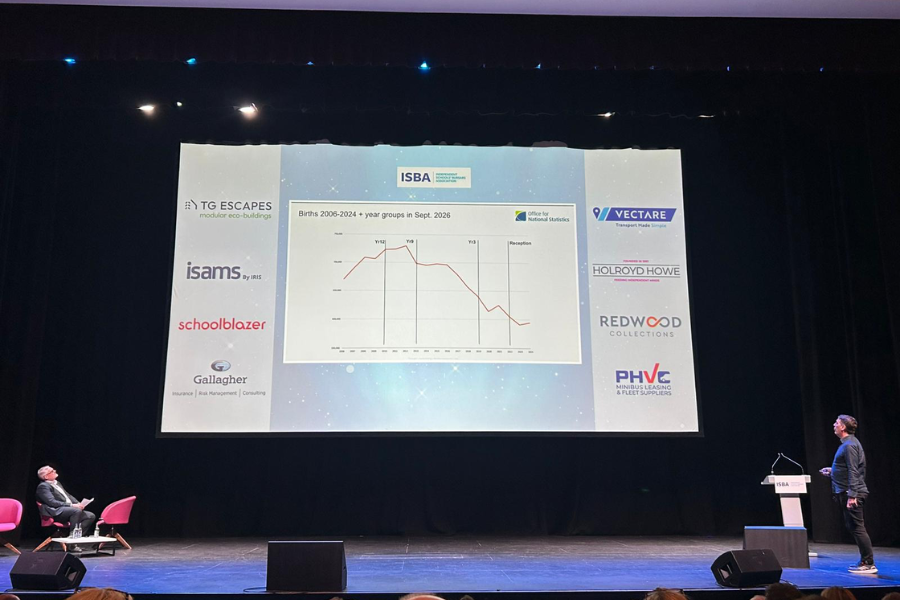
Today at the Independent Schools’ Bursars Association (ISBA) Annual Conference in Wales, Bonas MacFarlane’s Dr Guy Schady-Beckett delivered a keynote examining one of the defining issues facing British education over the next decade: a declining birth rate and the smaller cohorts of children now moving through the school system.
For both independent and state schools, the implications are significant.
For families, however, the picture may be rather more encouraging.
A Smaller Generation Moving Through Schools
Using Office for National Statistics data, Guy demonstrated how the number of children entering Reception, Year 3, Year 7 and beyond is projected to decline steadily over the coming years.
The trend is already beginning to work its way through the education system. While many schools remain full today, the demographic reality is clear: fewer children are being born in the UK, and that inevitably means fewer pupils available to schools in future admission cycles.
For schools, this creates increasing competition for enrolment.
Historically, many leading schools could rely on long waiting lists, strong word-of-mouth demand and relatively predictable admissions pipelines. The coming decade is likely to require a different approach.
Schools will need to work harder to communicate their strengths, define their identity and demonstrate value to prospective families.
Marketing Alone Is Not Enough
One of the central themes of Guy’s keynote was that schools cannot simply “market their way out” of demographic change.
The schools most likely to thrive will be those that combine strong communication with a genuinely compelling educational proposition.
Parents are becoming increasingly sophisticated consumers of education. They are asking deeper questions:
- What does this school genuinely stand for?
- How strong is the pastoral care?
- Does the academic offering suit my child specifically?
- What outcomes does the school achieve?
- Is there flexibility around pathways and support?
- Does the environment feel ambitious, kind and future-focused?
In a more competitive landscape, schools will need clarity, authenticity and confidence in answering those questions.
Why This May Benefit Families
While demographic pressure creates challenges for schools, it may also create opportunities for parents.
In many respects, the balance of power is shifting.
Families are likely to experience:
- More personalised admissions engagement
- Greater responsiveness from schools
- Increased availability of bursaries and financial support
- More openness to finding the “right fit” rather than simply selecting the most oversubscribed option
- A broader range of schools actively seeking to attract and retain strong families
For parents navigating the often complex world of school selection, this may ultimately create a more favourable environment than has existed for many years.
It is increasingly becoming a buyer’s market.
The Importance of Good Advice
Of course, more choice does not necessarily make decisions easier.
The UK independent sector remains extraordinarily varied, with schools differing enormously in ethos, academic style, pastoral culture, co-curricular emphasis and admissions expectations.
At Bonas MacFarlane, we work closely with families to help them navigate this landscape carefully and strategically.
Our advisory team supports parents through:
- School placements
- Academic assessments
- Admissions preparation
- ISEB and pre-test guidance
- Tutoring and mentoring
- Long-term educational planning
As the market evolves, expert guidance becomes increasingly valuable, not simply to gain entry to schools, but to identify the environment in which a child is most likely to thrive.
Looking Ahead
The demographic trends outlined at the ISBA Conference are unlikely to reverse quickly.
For schools, the years ahead will demand adaptability, innovation and clearer communication than ever before.
For families, however, this changing landscape may create real opportunity: greater access, greater dialogue and ultimately better educational outcomes for children.
The challenge for parents is no longer simply “getting in”.
It is making the most informed, strategic and thoughtful choice possible.