

The admissions process can make parents feel as though their child is being judged at every turn. But perhaps families are asking the wrong question.
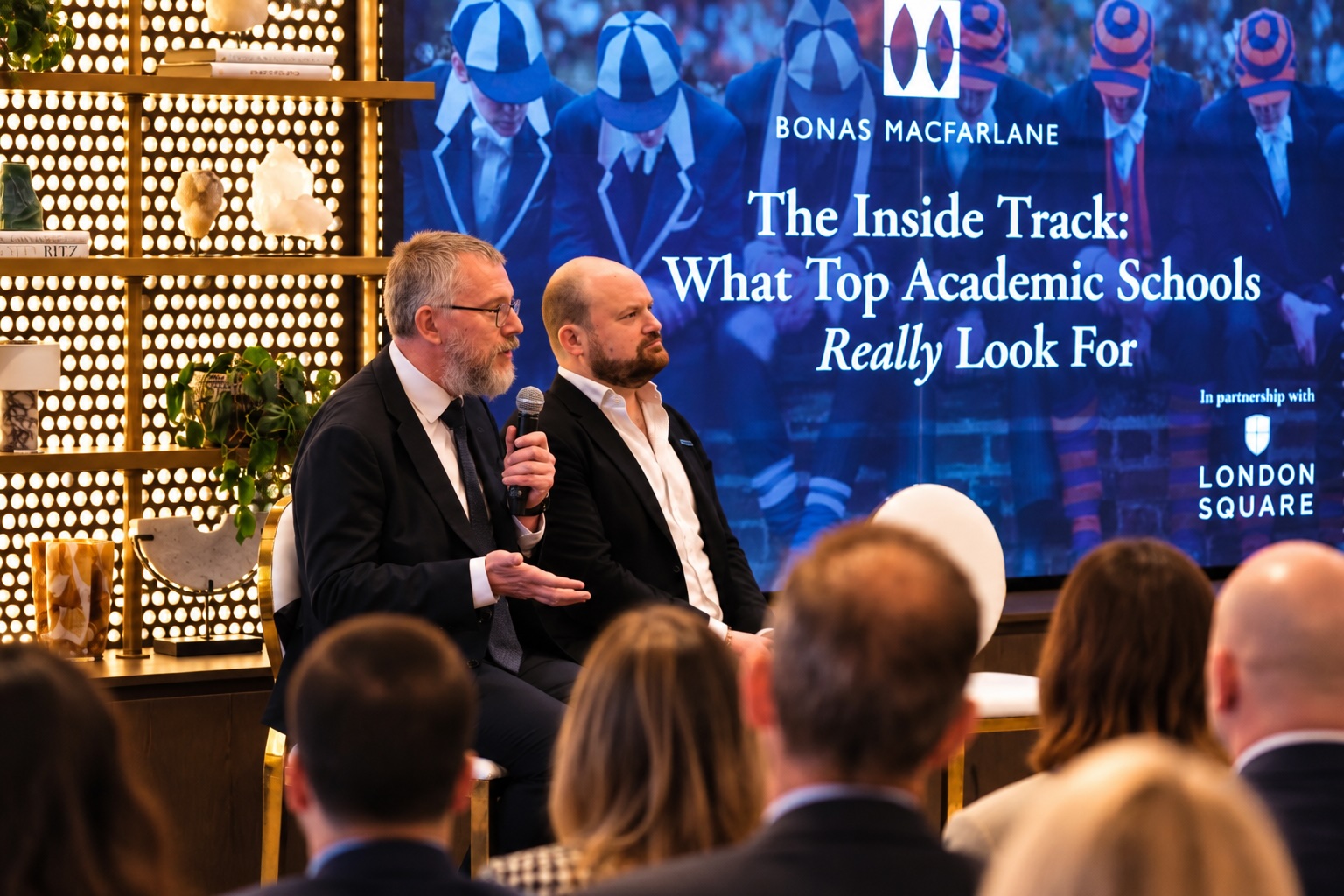
At a recent Bonas MacFarlane discussion in Mayfair, Charles Bonas and William Petty were joined by David Goodhew, former Head of Latymer Upper School and now Managing Director at Dukes Education, to explore what highly academic schools are really looking for — and what parents should be looking for in return.
The message was simple:
Don’t try to mould your child to fit a particular school. Find the school in which your child will flourish.
Flip the question
It is remarkably easy to start planning backwards: a particular university appears to require a particular senior school, which requires the right prep school, which requires the right preparation years earlier.
Before long, childhood can resemble an admissions strategy.
David Goodhew suggested turning that thinking around. Rather than asking, “How do I get my child into the top school?”, ask:
“What is the top school for my child?”
Schools are choosing children, but families are choosing schools too. Reputation and results matter, but they cannot tell you whether your child will be happy, challenged and supported there.
Don’t be frightened by the numbers
Application numbers at London’s best-known schools can be alarming. But headline ratios don’t tell the whole story.
Families increasingly apply to eight, nine or even ten schools, meaning many applicants have no intention of accepting every place they might be offered.
Applying to more schools isn’t necessarily safer. It means more tests, more interviews and more pressure on a ten- or eleven-year-old.
A thoughtful shortlist of schools that genuinely suit the child is usually more valuable than chasing every prestigious name.
Look at what schools do
School websites repeatedly promise curiosity, independence, creativity and collaboration.
Look beyond the language.
How does the school actually select its pupils? What does it test? What does its curriculum reward?
Increasingly, schools are using classroom assessments alongside traditional examinations and interviews. These reveal something much more interesting: what is this child actually like to teach?
Do they engage with new ideas? Listen to others? Collaborate? Respond positively when they don’t immediately know the answer?
These qualities are much harder to coach than a model interview response.
Don’t obsess over reasoning tests
Verbal and non-verbal reasoning have become an industry in their own right.
At Latymer Upper, David Goodhew examined how different parts of the entrance process predicted later GCSE and A-level performance. He told the audience that verbal and non-verbal reasoning were the weakest predictors, while English and Maths together were the strongest. Latymer subsequently removed VR and NVR from its entrance process.
Children should certainly be familiar with the format of tests they will sit. But there is an enormous difference between familiarisation and spending hundreds of hours drilling questions.
Those hours have an opportunity cost: reading, sport, friends, creativity and simply being a child.
Reading, reading, reading
The most practical advice of the morning was beautifully simple:
Read.
Children should encounter a wide variety of material — fiction, non-fiction, poetry and journalism — rather than simply working through books by the same favourite authors.
Parents can help by reading with their children, discussing ideas, noticing unfamiliar words and encouraging them to work out meaning from context.
Reading isn’t simply preparation for English. A confident reader can understand a maths question more quickly, articulate an idea more clearly in an interview and engage confidently with unfamiliar material.
Good tutoring isn’t test drilling
The panel drew an important distinction between education and drilling for tests.
Good tutoring identifies gaps, rebuilds foundations, stretches thinking and encourages curiosity.
Bad tutoring starts with the test.
Past papers have their place towards the end of the process, when children need to learn timing, format and examination technique. But they are not learning tools and they certainly aren’t a curriculum.
The objective should be education first and examination technique second.
Don’t coach the personality out of the interview
Some interview preparation is sensible. An interview with an unfamiliar adult is an artificial experience, and practising the situation can make it less intimidating.
What parents should resist is scripting answers.
Instead, help children remember the things they genuinely enjoy.
Charles recalled one boy who showed little enthusiasm in an interview until he began talking about cooking. Suddenly he became animated about herbs and chillies. He hadn’t thought to mention it because cooking didn’t win prizes or house points.
But genuine enthusiasm is memorable.
It could be cooking, aircraft, insects, fishing, coding or an obscure period of history. It doesn’t need to look impressive on a CV.
Genuine curiosity is interesting because it is genuine.
Don’t confuse results with teaching
Perhaps the most useful question parents could ask a highly academic school is:
“What are your value added scores?”
League tables show the grades children leave with. They don’t necessarily show how much the school contributed to those grades.
A school selecting exceptionally academic children should produce excellent examination results.
The more interesting question is how much progress those children make once they arrive.
Ask about value-added performance in English and maths. Ask what happens in lessons. Look at the curriculum and the space given to art, music, design, sport and independent thinking.
And talk to pupils.
If a school says it produces creative, curious and independent young people, look for the evidence.
The real inside track
There is no secret formula for getting into a highly selective school.
Give children strong foundations in English and Maths. Encourage them to read widely. Let them pursue things they genuinely find fascinating. Give them good educational support where they need it. Familiarise them with assessments without allowing those assessments to dominate childhood.
And when choosing schools, resist the noise.
The goal isn’t to win the admissions process.
It is to find a school where your child can learn, grow, make friends, discover what they are good at — and flourish.
This article draws on “The Inside Track: What Are Top Academic Schools Really Looking For?”, a Bonas MacFarlane panel discussion organised by the Independent Schools Show, generously hosted by London Square in their Mayfair showroom, with Charles Bonas, Founder of Bonas MacFarlane; William Petty, Managing Director of Bonas MacFarlane Consulting; and David Goodhew, Managing Director at Dukes Education and former Head of Latymer Upper School.